
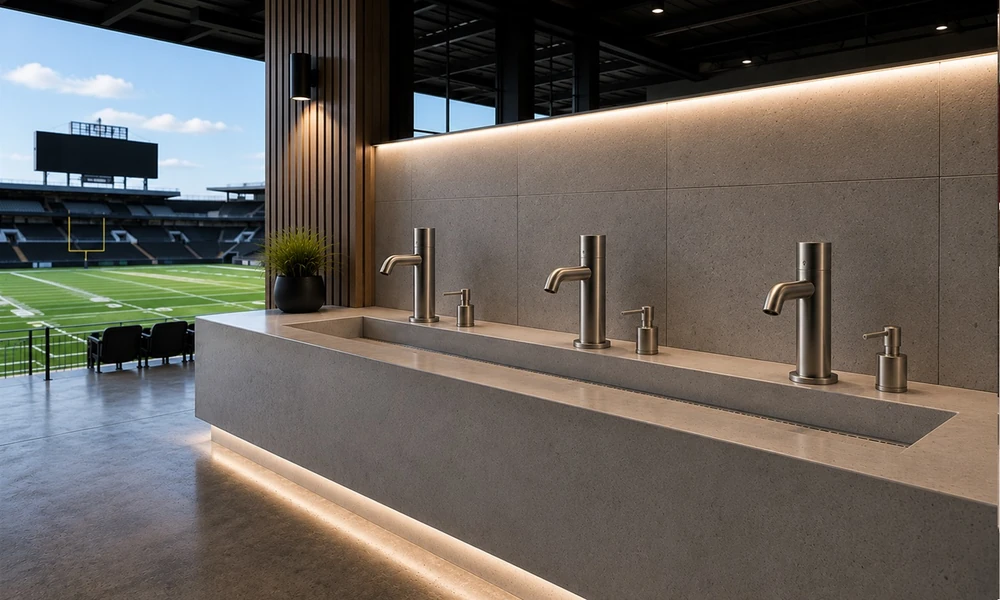
Stadium restrooms face a demand pattern unlike any other building type. Tens of thousands of fans arrive within hours, and most restroom visits cluster into short windows at halftime, between periods, and after the final whistle. Mercedes-Benz Stadium in Atlanta seats about 71,000 fans for football (Mercedes-Benz Stadium), and restroom design at that scale has to perform for every one of them.
Why is stadium restroom demand so concentrated?
Stadium restroom demand is concentrated because event schedules dictate when fans can leave their seats. Breaks in play create surges in which restrooms move from empty to full within minutes. Designs that work well under steady traffic can fail completely under these short, intense peaks.
Which design choices matter most during peaks?
Four design choices make the biggest difference during peak demand:
- Doorless entries that let fans enter and exit without congestion
- Separate circulation paths for entering and leaving
- Clear occupancy indicators on every compartment
- Enough handwashing and drying stations to avoid secondary lines
Which venues show how integrated restroom products perform at scale?
Major venues show how integrated restroom products perform under extreme use. Partitions, washroom accessories, and related products from a single integrated manufacturer are installed in venues such as Mercedes-Benz Stadium, U.S. Bank Stadium, and Hayward Field (ASI Group). These projects demonstrate how coordinated products hold up to event-day surges and heavy cleaning.
Why does durability matter in stadiums?
Durability matters because stadium restrooms see rough use, rapid cleaning, and long seasons. Partitions and accessories must withstand slamming doors, leaning, and frequent chemical cleaning without loosening or corroding.
How do plumbing codes address stadium fixture counts?
Plumbing codes address stadium fixture counts through occupancy-specific ratios. Model plumbing codes assign different minimum water closet ratios for men and women in stadiums and arenas, recognizing that women’s restrooms need more fixtures to serve the same number of users (International Code Council). Many venues exceed code minimums to shorten lines.
How do venues reduce women’s restroom lines?
Venues reduce women’s restroom lines by adding fixtures beyond code minimums, converting some restrooms to all-gender layouts during certain events, and placing restrooms evenly around the concourse so no single location is overloaded.
Why does handwashing capacity matter at events?
Handwashing capacity matters because fans who face a line at the sink often skip handwashing entirely. Germs spread more easily from wet hands, which makes drying as important as washing (Centers for Disease Control and Prevention). Matching sink and dryer counts to compartment counts keeps the full sequence moving.
How do cleaning crews keep up during events?
Cleaning crews keep up by working between surges and focusing on high-touch surfaces, refills, and floors. Accessories with high capacity and partitions that resist moisture help crews restore restrooms quickly before the next wave of fans arrives.
How are venues using data to plan restrooms?
Venues are using attendance data, concession sales, and restroom sensors to understand when and where demand peaks. That information helps operators adjust staffing, open overflow restrooms, and plan future renovations around real patterns rather than assumptions.
How do concourse layouts affect restroom performance?
Concourse layouts affect restroom performance because fans choose the nearest restroom, not the least crowded one. Restrooms clustered in one area overload quickly, while evenly distributed restrooms spread demand. Wayfinding signs that show distances or wait times can also steer fans toward less busy facilities during breaks in play.
Should venues add family and all-gender restrooms?
Many venues add family and all-gender restrooms to serve parents with young children, fans who need assistance, and anyone who prefers a private room. These rooms also give operators flexibility when demand shifts between events with different crowds.
What is the takeaway for venue designers?
Stadium restrooms must be designed for the peak, not the average. Venues that combine durable, integrated restroom products with smart layouts, generous fixture counts, and responsive operations deliver a better experience for every fan on event day.